
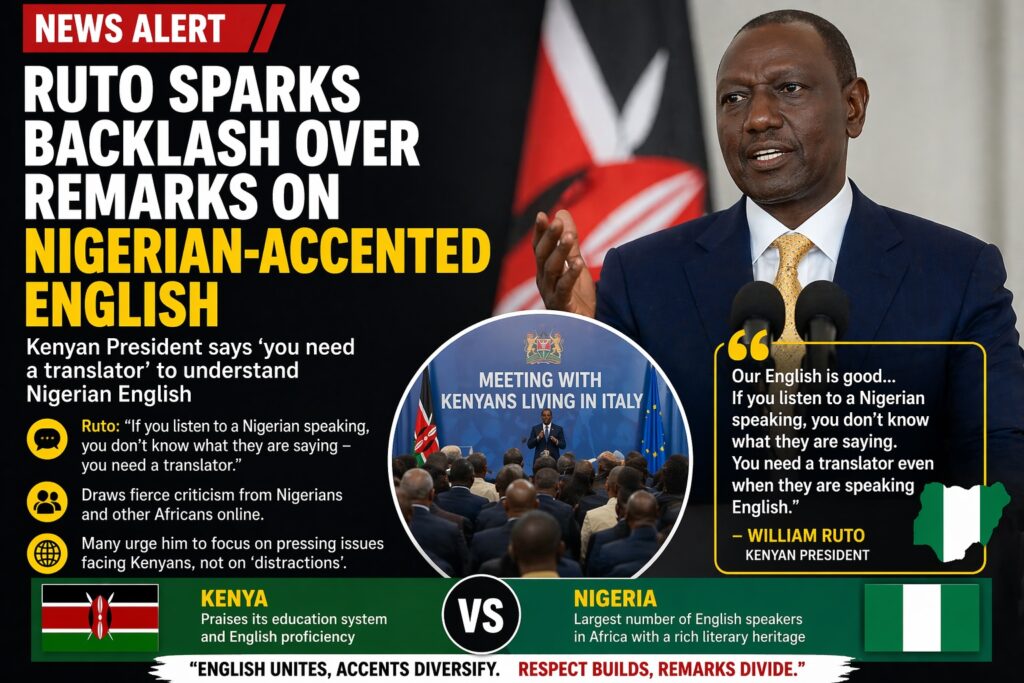
Kenyan President William Ruto has sparked a social media backlash after remarks suggesting that Nigerian-accented English can be difficult to understand.
Speaking to Kenyans living in Italy on Monday, Ruto said that one might “need a translator” when listening to a Nigerian speak English, while also praising Kenya’s strong command of the language.
The comments drew sharp criticism online, with many Nigerians and other Africans accusing the president of belittling a fellow African nation.
“English is a colonial language, not a measure of intelligence, capability, or national progress,” wrote Zimbabwean journalist Hopewell Chin’ono.
Both Kenya and Nigeria, as former British colonies, use English as an official language. However, each country has developed distinct spoken forms shaped by local linguistic influences. Nigeria, with more than 500 indigenous languages, has a unique cadence and intonation, while Kenya’s mix of Bantu, Nilotic and Cushitic languages informs its own accent.
During his address, Ruto praised Kenya’s education system and its role in fostering English proficiency, but reiterated that Nigerian English can be challenging to follow for some listeners. His remarks drew laughter from the audience.
The comments quickly circulated online, prompting criticism from users who described them as unnecessary and dismissive. Some argued that the remarks reflected lingering colonial attitudes toward language and identity.
Former Nigerian senator Shehu Sani responded on X, pointing to Nigeria’s literary heritage, including Nobel laureate Wole Soyinka and celebrated authors Chinua Achebe and Chimamanda Ngozi Adichie.
Others urged the Kenyan leader to focus on domestic issues such as the rising cost of living and unemployment rather than engaging in remarks that could strain regional goodwill.
Online exchanges between Kenyans and Nigerians are not uncommon, often centred on economic comparisons, pop culture and sport, and at times political commentary.
Earlier this month, Nigerian President Bola Tinubu faced criticism from Kenyans after suggesting that Nigerians were “better off” than citizens of some other African countries, including Kenya. While Ruto did not directly reference those comments, some online reactions linked the two developments.
There has been no official statement from the Kenyan government regarding the remarks, though some Kenyans have defended the president, saying the comments were intended humorously and have been taken out of context.
Nigeria has the largest number of English speakers in Africa, and its variant—often referred to as Nigerian English—has evolved into a recognised form shaped by local culture and everyday use. Expressions from Nigerian English have increasingly gained global recognition, reflecting the country’s growing cultural influence.
Sharing is caring!