
Russia is stepping up efforts to strengthen its political, military and economic influence in Africa as its war in Ukraine continues, while African governments are using growing international competition to pursue their own strategic and development interests.
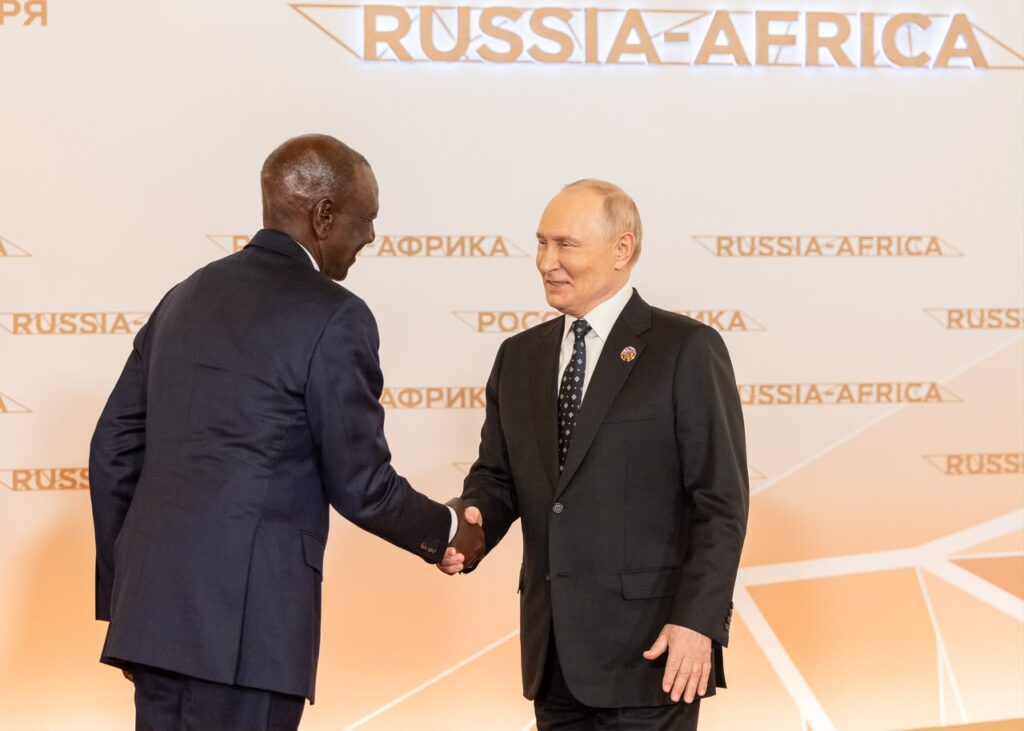
The relationship was a central focus of the third Russia-Africa Summit, hosted by President Vladimir Putin in Moscow, where the Kremlin sought to present Russia as an alternative development and security partner to Western countries.
Putin accused Western governments of exploiting Africa’s natural resources, maintaining colonial-era attitudes and using debt to constrain the continent’s development. He said Russia offered a different approach based on cooperation in trade, technology and investment.
“Our business does not engage in the predatory, neo-colonial exploitation of natural and human resources,” Putin said, arguing that Russian companies contributed to local employment and government revenues.
Delegations from 48 of Africa’s 54 countries attended the two-day summit, with 22 represented by heads of state, according to Kremlin aide Yury Ushakov. This compared with 17 heads of state at the 2023 summit and 43 at the inaugural gathering in 2019.
The attendance provided Moscow with an opportunity to demonstrate that it retains diplomatic relationships across Africa despite mounting Western sanctions and international pressure over its invasion of Ukraine.
However, African countries are not necessarily aligning themselves with Russia at the expense of their existing relationships with Western powers.
Tighisti Amare, director of the Africa Programme at Chatham House, describes this approach as “diversified non-alignment”, in which governments maintain relationships with multiple international partners rather than committing to a single geopolitical camp.
The calculations vary across the continent. Some governments are seeking military assistance, while others are interested in agricultural supplies, energy investment, technology, trade and diplomatic support.
Will Brown, an Africa policy specialist at the European Council on Foreign Relations, says African governments are also using competition among international partners to negotiate better terms and expand their options.
Russia expands its security footprint
Security cooperation remains one of the most visible aspects of Russia’s engagement with Africa.
Moscow has expanded its military presence through the Africa Corps, a paramilitary organisation that took over much of the work previously undertaken by the Wagner Group following its 2023 mutiny against the Kremlin.
The Sahel, a semi-arid region stretching across Africa south of the Sahara, has emerged as a major area of Russian activity.
Anna Ida Rock, a researcher at the Swedish Defence Research Agency, says Africa Corps has a reported presence in Burkina Faso, the Central African Republic, Equatorial Guinea, Libya, Mali and Niger.
Russian military instructors have also been reported in the Republic of Congo, Madagascar and Togo, although reports concerning Togo remain disputed.
Russia is also pursuing a proposed naval facility in Sudan, which would provide it with a potential strategic foothold along the Red Sea.
The transition from Wagner to Africa Corps represents more than a change of name. The new organisation operates under Russia’s Defence Ministry and military intelligence structures, with a greater emphasis on military training, advising and protecting strategic installations.
Many of its personnel previously served in Wagner. The group, however, remains active in the Central African Republic, where the government has resisted the transition.
The outcomes of Russia’s security partnerships have varied.
In Mali, Russian forces supported government operations to retake the north-eastern city of Kidal. However, insecurity has persisted and Africa Corps has suffered significant losses.
In Burkina Faso, Russian personnel have focused partly on protecting the government amid political instability, while their role in Niger has been more limited.
In the Central African Republic, Russian forces have helped the government maintain its position, but continuing insecurity has raised questions about the extent to which the arrangement has improved civilian safety.
These developments illustrate the distinction between military cooperation that strengthens governments and security arrangements that deliver lasting protection for communities.
Trade ambitions face a significant gap
Despite Russia’s growing political and security engagement, its economic footprint in Africa remains relatively modest compared with that of other major international partners.
Russia-Africa trade was estimated at $27 billion in 2025, below the $40 billion target Moscow set in 2019. Putin has now announced a new ambition to increase bilateral trade to more than $50 billion.
The figures remain considerably lower than Africa’s trade with China and the European Union. China-Africa trade reached approximately $348 billion in 2025, while trade between the EU and Africa stood at about $395 billion.
Agriculture is among the areas where Russia has established stronger commercial relationships.
Putin said Russia exported 13 million metric tonnes of agricultural products to Africa in the first nine months of 2026, highlighting grain and fertiliser supplies as important areas of cooperation.
Energy is another focus, although projects are at different stages of development.
Russia’s state nuclear energy corporation, Rosatom, is constructing Egypt’s El Dabaa nuclear power plant. Other proposals involving floating nuclear power plants have yet to progress to construction.
At the summit, Moscow also promoted cooperation in digital technology and the local production of medicines and vaccines.
However, translating these commitments into tangible benefits for African economies will require financing, infrastructure, manufacturing capacity and skilled personnel.
For African countries, the central question is whether proposed partnerships can support industrialisation, technology transfer, employment creation and stronger domestic production.
Arms cooperation and recruitment concerns
Military equipment remains another component of Russia’s engagement with African governments.
Ethiopia illustrated this dimension at the summit, with Prime Minister Abiy Ahmed saying his country had received Russian Su-35 fighter jets and would acquire four S-400 long-range air defence systems.
The announcement comes amid renewed tensions and fighting in northern Ethiopia, raising concerns about the possibility of a wider return to conflict.
Russia’s broader arms exports, however, have declined significantly in recent years.
The Stockholm International Peace Research Institute reports that Russian arms exports fell by 64 per cent between 2016–2020 and 2021–2025, while the United States and China remained among the world’s leading arms suppliers.
Closer military relations have also attracted scrutiny over the recruitment of African nationals into Russia’s armed forces.
Amnesty International has documented cases of Africans allegedly recruited through deception, coercion and economic hardship, saying the circumstances in several cases amounted to human trafficking.
Russia has denied involvement in unlawful recruitment.
In February, the Russian Embassy in Kenya said Russian authorities had never engaged in the illegal recruitment of Kenyan citizens, while maintaining that foreign nationals could voluntarily enlist in its armed forces.
The allegations highlight the importance of protecting African citizens from deceptive recruitment practices and ensuring that any military engagement is conducted transparently and in accordance with national laws.
From summit declarations to practical outcomes
The Moscow summit produced a joint declaration, an agreement on civilian artificial intelligence and a Russia-Africa action plan covering the 2027–2029 period.
The African Union Commission and Russia also signed a cooperation plan covering security, trade, energy, agriculture, health, education and technology.
The Commission has described the arrangement as a framework for cooperation rather than a legally binding agreement.
Amare says implementation will depend on whether the commitments are supported by adequate financing, clear institutional responsibilities and measurable deadlines.
For African governments, the challenge will be to ensure that diplomatic engagements translate into practical outcomes for their economies and populations.
The continent has increasingly become an arena of competition among major global powers, including China, the United States, Russia, the European Union, Türkiye and Gulf states.
That competition presents opportunities to attract investment, diversify markets and strengthen international cooperation. It also requires African governments to negotiate from clearly defined national and continental priorities.
Putin is seeking to strengthen Russia’s position in Africa as Moscow confronts international isolation over the war in Ukraine. African governments, meanwhile, are pursuing partnerships shaped by their own security, economic and diplomatic calculations.
The long-term significance of the relationship will therefore depend less on summit declarations and diplomatic photographs than on whether the commitments deliver measurable benefits for African countries.
Sharing is caring!