
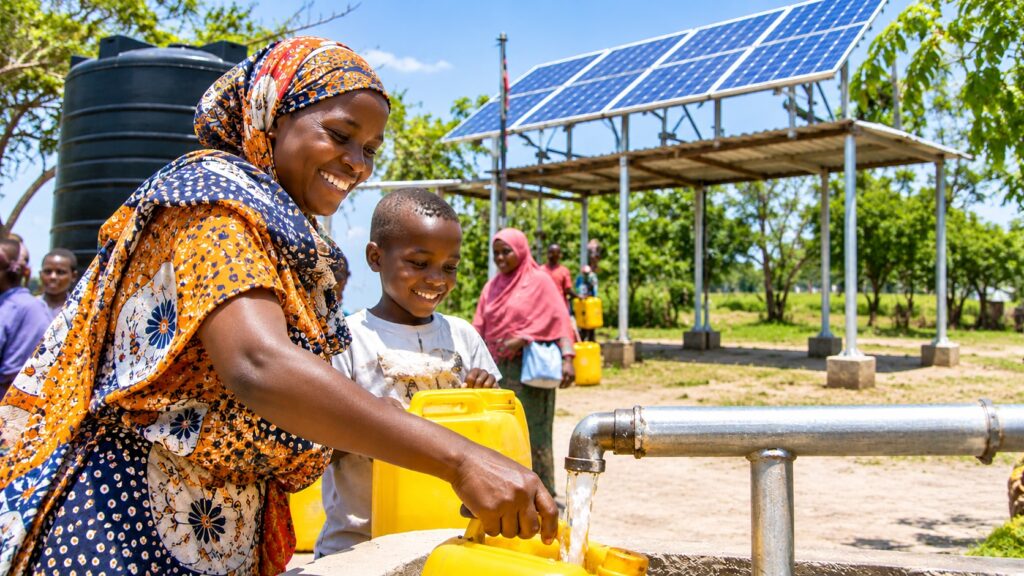
A solar-powered desalination initiative in Lamu County has won international recognition, demonstrating how African innovation can improve access to clean water while strengthening peaceful relations between communities across borders.
A community in Kenya’s remote coastal region has demonstrated how a local response to a development challenge can become an internationally recognised model for innovation, resilience and peaceful coexistence.
The Kiunga Solar Desalination and Water-for-Peace Initiative in Lamu County has won Gold at the 2026 International Water Association (IWA) Project Innovation Awards in Glasgow, Scotland, earning recognition for its approach to addressing water scarcity while promoting peace.
The project combines solar energy, desalination technology and community-centred development to provide approximately 5,000 litres of safe water every hour. It serves 573 households, representing about 3,500 people, while also supporting essential institutions, including schools and health facilities.
Its recognition is particularly significant because Kiunga was the only African project among the 2026 IWA award winners. The awards attracted 320 submissions from 65 countries, with 24 projects recognised across six categories.
Located near Kenya’s border with Somalia, Kiunga has historically faced significant water shortages and limited access to reliable freshwater sources. For residents, obtaining safe drinking water has been a persistent challenge, affecting households, livelihoods and access to essential services.
The initiative has responded by harnessing solar energy to power a desalination system that transforms saline groundwater into safe water for consumption. The water is distributed through a 15.1-kilometre network serving households and public institutions, with the network also extended towards neighbouring Ishakani.
By using renewable energy, the project offers a locally appropriate approach to water provision while reducing dependence on conventional energy sources.
However, its most distinctive contribution goes beyond the technology.
Kiunga’s location along the Kenya-Somalia border means that communities from neighbouring Jubaland also cross into Kenya to access clean water. This shared resource has created opportunities for interaction and cooperation among people living on opposite sides of an international boundary.
Through its Water-for-Peace model, the initiative demonstrates how access to an essential resource can become a common interest that brings communities together, strengthens relationships and supports peaceful coexistence.
This is particularly relevant in regions where competition over scarce natural resources can place pressure on relationships between communities.
Receiving the award in Glasgow on behalf of the Lamu County Government and Governor Issa Abdalla Timamy, Shee Kupi Shee, the county’s Director of Disaster Risk Management and Peace Building, described the recognition as a proud moment for Lamu and the people of Kiunga.
He said the award affirmed the belief that water infrastructure can contribute to resilience, dignity and peace beyond its traditional role in service delivery.
Shee, who developed the Kiunga Water-for-Peace model, also highlighted the influence of his experience through the Rotary Peace Fellowship and Bahçeşehir University in Türkiye. His social change initiative during the fellowship focused on refugee integration and explored ways of enabling displaced populations and host communities to coexist with dignity and inclusion.
That experience strengthened his belief that sustainable development solutions should bring communities together rather than deepen divisions.
The Kiunga achievement also highlights the importance of locally driven innovation in addressing Africa’s development challenges.
Across the continent, communities face growing pressure from water scarcity, climate change and inadequate infrastructure. Remote and arid regions are particularly vulnerable, often requiring solutions that are affordable, sustainable and adapted to local conditions.
Kiunga offers an example of how renewable energy and appropriate technology can help address these challenges. Solar-powered desalination is particularly relevant to coastal communities where saline groundwater is available but requires treatment before it can be safely consumed.
The award also gives Lamu County an opportunity to share its experience with international water institutions, development partners and organisations working in climate resilience and peacebuilding.
For other African communities, the lessons extend beyond water provision. They include understanding local needs, involving communities in development planning and designing infrastructure that delivers wider social benefits.
For the people of Kiunga, the most important achievement remains improved access to safe water. For Kenya and Africa, however, the project carries a wider message: innovation does not have to originate in major cities or advanced research centres. It can emerge from a community confronting a difficult challenge and finding a practical way to overcome it.
Kiunga’s experience demonstrates that appropriate technology, renewable energy and community participation can turn a local response to water scarcity into a model with lessons for the wider world.
Sharing is caring!