
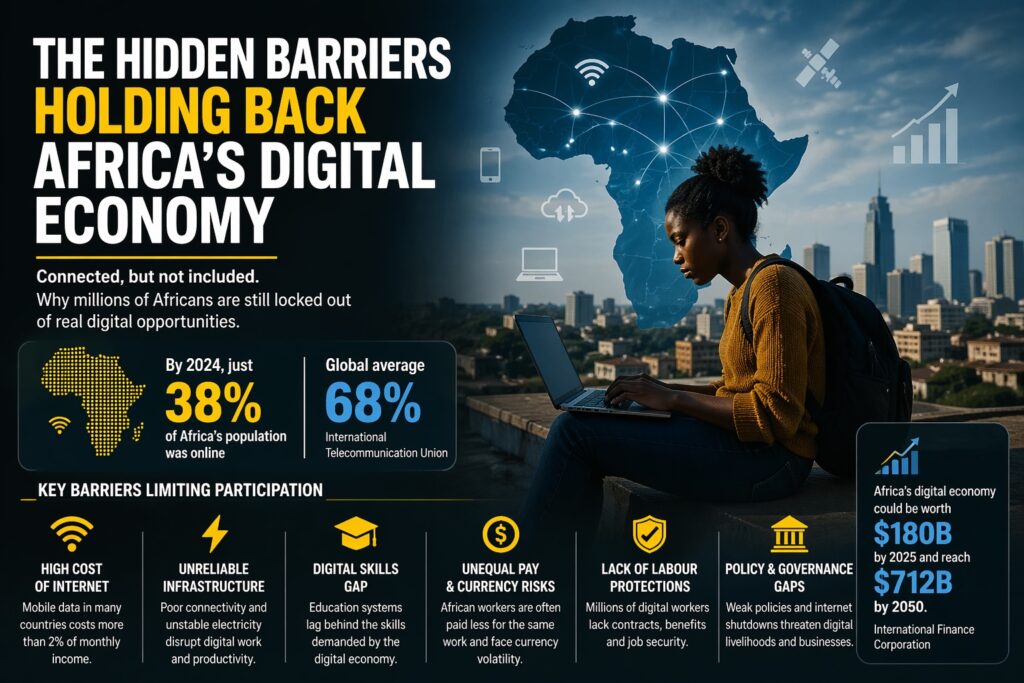
By 2024, only 38% of Africa’s population was online, according to the International Telecommunication Union—far below the global average of 68%. For a continent often described as digital-first, this gap exposes deeper structural barriers that continue to limit access, opportunity, and meaningful economic participation, particularly for its youth.
Africa’s digital economy is frequently framed as a pathway to opportunity, driven by one of the youngest populations in the world. Millions of young people are increasingly turning to the internet for work and access to global markets. However, the infrastructure, policies, and economic systems needed to support this shift remain unevenly developed, underscoring a critical reality: connectivity alone does not guarantee participation.
In countries such as Nigeria, Ghana, Uganda and South Africa—where mobile data remains among the most expensive globally, with South Africa ranking 135 out of 237 countries according to BestBroadbandDeals.co.uk—high data costs and unreliable electricity continue to undermine sustained participation in digital work. Freelancers and remote workers are often forced to rely on expensive mobile data and alternative power sources just to remain active on global platforms.

Affordability remains a major constraint. According to the Alliance for Affordable Internet, mobile data in many African countries still exceeds 2% of average monthly income, surpassing the affordability benchmark set by the United Nations. For digital workers, this translates into additional operational costs—data, electricity, and equipment—that their counterparts in more stable environments do not face.
Beyond infrastructure, a significant challenge lies in the gap between digital access and digital preparedness. While Africa’s youth are often described as digitally savvy, many education systems have yet to fully integrate digital economy competencies into their curricula. The World Bank has warned of a widening digital skills gap, with graduates entering labour markets that increasingly demand advanced technical capabilities.
Without sustained investment in digital skills development, millions risk being connected but excluded from higher-value opportunities within the digital economy.
Even for those who successfully access global digital markets, disparities persist. Research by the Oxford Internet Institute shows that workers from lower-income countries are often paid less for similar tasks than their counterparts in wealthier regions. Currency volatility further compounds this inequality. Identical earnings can translate into vastly different outcomes depending on exchange rates, inflation, and the cost of maintaining digital work.
Perhaps the most critical challenge is the absence of robust policy frameworks to protect digital workers. Across the continent, millions of freelancers operate without formal contracts, labour protections, health benefits, or income security. Classified as independent contractors, they remain exposed to sudden platform changes, unpaid work, and unstable income streams.
Yet the stakes are significant. The International Finance Corporation estimates that Africa’s digital economy could be worth $180 billion by 2025, with potential to reach $712 billion by 2050. This raises a fundamental question: what does participation in the digital economy mean if workers lack bargaining power and protections?
Recent developments across the continent highlight these challenges. In South Africa, ride-hailing drivers working for platforms such as Uber and Bolt have challenged their classification as independent contractors, arguing that platform companies exert substantial control over their work. In Kenya, content moderators employed by outsourcing firms have drawn global attention after raising concerns about working conditions, psychological harm, and compensation—despite performing critical roles in maintaining global digital platforms.
Elsewhere, structural vulnerabilities are even more pronounced. In Uganda, internet shutdowns during periods of political tension have disrupted digital livelihoods, cutting off freelancers and online businesses from global markets. In Nigeria, freelancers face persistent payment delays and foreign exchange constraints, with some waiting weeks to receive earnings while incurring additional transaction costs.
These realities point to a broader issue: while digital work is global, it remains deeply dependent on local infrastructure, governance, and financial systems.
As global platforms—largely owned by companies in North America and East Asia—continue to shape access to digital opportunities, Africa’s position within the digital economy remains largely that of a labour provider rather than a value creator.
For the continent to secure a stronger footing, participation alone will not be enough. There must be deliberate investment in digital infrastructure, local platforms, and regional payment systems that reduce dependence on external intermediaries. At the same time, stronger labour protections are needed to safeguard the growing workforce engaged in digital employment.
Ultimately, Africa’s digital future will not be defined by how many people are connected, but by how many are empowered to create, own, and benefit from the systems that drive the digital economy.
Only then can the continent transition from being a global workforce to becoming a true global stakeholder.
[This publication was supported by Africa No Filter]
The findings and conclusions contained within are those of the author and do not necessarily reflect the positions or policies of Africa No Filter.
About Vanessa Emeadi
Vanessa Emeadi is a Media and Communications Specialist and storyteller passionate about youth advocacy, community development, and the future of work in Africa.