
Nearly five million children died before their fifth birthday in 2023, most from causes that are preventable—malnutrition, infectious diseases and complications around birth. The disparity is stark: children born in the poorest parts of the world are up to 80 times more likely to die before age five than those in the wealthiest countries.
Closing this gap is at the heart of the work by the Gates Foundation, which is investing in health, nutrition and innovation to ensure that where a child is born does not determine whether they survive or thrive.
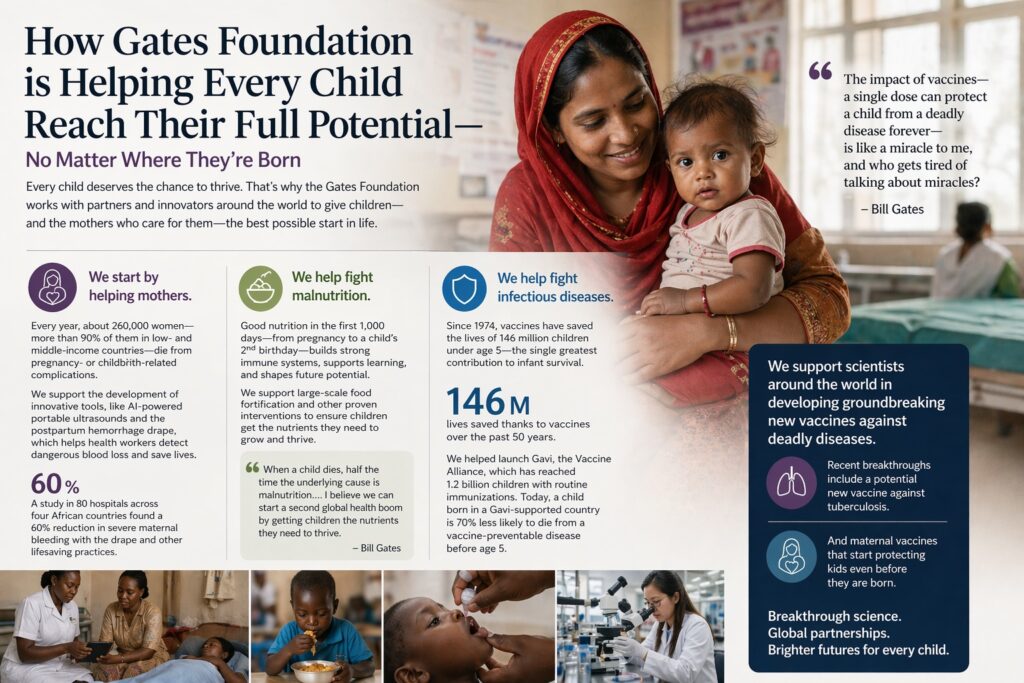
The approach begins with mothers. Each year, about 260,000 women—more than 90 percent in low- and middle-income countries—die from pregnancy- or childbirth-related complications. Improving maternal health is critical not only for saving lives, but also for giving children a stronger start.
To address this, the foundation supports the development and deployment of practical, life-saving tools. These include portable, AI-powered ultrasound devices that connect to mobile phones, enabling nurses and midwives in remote areas to monitor pregnancies and detect complications early. Even simple innovations are making a difference. The postpartum haemorrhage drape—a low-cost, V-shaped device used during childbirth—helps health workers quickly identify dangerous blood loss, the leading cause of maternal deaths. Studies across African hospitals have shown that using such tools alongside proven practices can reduce severe maternal bleeding by as much as 60 percent.
Beyond childbirth, nutrition plays a defining role in a child’s future. The first 1,000 days—from pregnancy to a child’s second birthday—are critical for brain development, immune strength and long-term health. Yet malnutrition remains an underlying factor in roughly half of all child deaths.
The foundation is working with partners to expand access to nutritious foods and scale up food fortification programmes, ensuring essential micronutrients like vitamin A and folate reach vulnerable populations. These interventions not only save lives but also improve learning outcomes and future earning potential.
Fighting infectious diseases is another key pillar. For decades, millions of children have died from diseases that are preventable or treatable elsewhere. Vaccines have been one of the most powerful tools in changing that reality. According to research published in The Lancet, vaccines have saved 146 million lives of children under five since 1974—making them the single greatest contributor to improved child survival over the past half-century.
The Gates Foundation has played a central role in expanding access to immunisation. In 2000, it helped launch Gavi, the Vaccine Alliance, which has since reached more than 1.2 billion children with routine vaccines. Today, a child born in a Gavi-supported country is 70 percent less likely to die from a vaccine-preventable disease before the age of five than at the start of the century.
Innovation continues to drive progress. The foundation supports scientists around the world in developing new vaccines against deadly diseases, including promising breakthroughs in tuberculosis and maternal vaccines that begin protecting children even before birth.
For Bill Gates, the impact of vaccines remains one of the most powerful examples of what science can achieve. A single dose can protect a child from a deadly disease for life, a transformation he has often described as nothing short of a miracle.
The work is far from over. Millions of children are still at risk, and progress remains uneven across regions. But through a combination of science, partnerships and targeted investment, efforts are underway to change the trajectory.
At its core, the mission is simple: every child, regardless of where they are born, deserves the chance to grow up healthy, learn, and fulfil their potential.
Sharing is caring!