
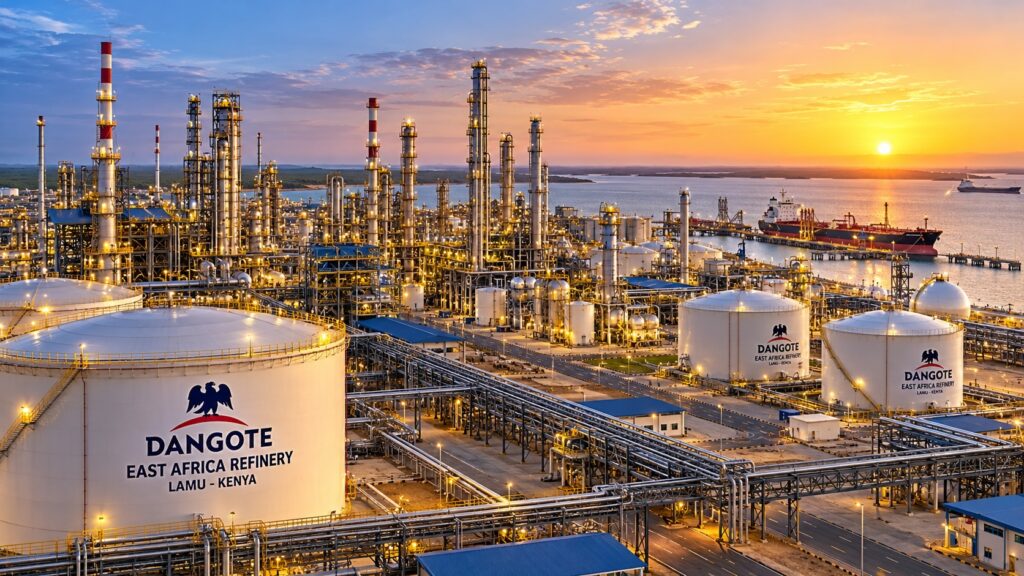
LAMU, Kenya Oct 15– Africa has spent decades exporting much of its crude oil while importing the refined petroleum products that power its economies. From fuel used by public transport and agricultural machinery to energy consumed by factories and airlines, the continent has remained heavily exposed to international supply chains and price fluctuations.
A proposed $16 billion oil refinery in Lamu, led by Nigerian industrialist Aliko Dangote, could begin to change that equation.
With a planned capacity of 700,000 barrels of crude oil per day, the Dangote East Africa Refinery is expected to become one of the largest refining facilities in the world and a major addition to Africa’s industrial infrastructure.
The project was officially launched on September 30, 2026, in a ceremony attended by Kenyan President William Ruto, Ugandan President Yoweri Museveni, Ethiopian Prime Minister Abiy Ahmed and other African leaders.
Dangote described the investment as a turning point in the continent’s industrial ambitions.
“This is Africa coming together to build Africa. Today we are not simply breaking ground for a refinery; we’re breaking ground for a new chapter in Africa’s industrial journey to a brighter future,” he said.
His remarks capture the wider significance of the project. For Kenya, it is an opportunity to position Lamu as a major energy and industrial hub. For East Africa, it could provide additional refining capacity and strengthen regional energy security. For the continent, it represents another attempt to move away from exporting raw materials and importing finished products.
Breaking the cycle of exporting crude and importing fuel
Africa is home to some of the world’s significant oil-producing countries, including Nigeria, Angola, Libya and Algeria. Yet the continent has struggled to develop sufficient refining capacity to meet its demand for petroleum products.
The result has been an expensive dependence on imported refined fuel, exposing African economies to international price movements, supply disruptions, foreign exchange pressures and geopolitical tensions.
Dangote argued that the existing model has denied African countries opportunities to create jobs and develop industries around their natural resources.
“For too long, our continent has actually been rich in resources but poor in value creation and addition. We have exported crude oil and imported refined products,” he said.
“Such practice only leads to us exporting our jobs and opportunities that should remain on the continent and lead us into importing poverty into our nations. Africa cannot build lasting prosperity by exporting what it has and importing what it needs.”
The proposed Kenyan facility seeks to extend the industrial model demonstrated by Dangote’s existing refinery in Nigeria to East Africa.
The Lagos facility, with a capacity of 650,000 barrels per day, began operations in 2024 and has become a major supplier of refined petroleum products.
The Lamu project is expected to serve Kenya and neighbouring markets, including Uganda, Tanzania, Rwanda, Ethiopia and South Sudan.
A refinery in the region could provide a closer source of supply, reduce reliance on long-distance imports and potentially lower some of the costs associated with transporting finished petroleum products.
However, the effect on pump prices will depend on the cost of crude, refining, distribution, taxes, financing and competition. A refinery does not automatically translate into cheaper fuel, but it could give the region greater control over supply and additional options in the market.
Ruto’s vision for a regional industrial hub
President Ruto has positioned the investment as part of Kenya’s broader ambition to become a regional centre for energy, manufacturing and trade.
Speaking at the groundbreaking ceremony, he described the project as an opportunity to turn years of planning into a major industrial undertaking.
“Today we break ground in Lamu. We turn a proposal into an industry. We transform a long-held ambition into real opportunity for Kenya, for East Africa and for our continent, Africa,” Ruto said.
The President said the refinery would be much more than a petroleum processing facility, linking it to energy security, industrialisation and regional integration.
“This is bigger than a refinery. It is an investment in energy security, industrialisation, and regional integration,” he said.
The project is expected to form part of an integrated industrial complex incorporating a 1,000-megawatt power plant and manufacturing facilities for petrochemicals, fertilisers and other petroleum-related products.
This could create opportunities for industries that depend on reliable energy and industrial inputs, including manufacturing, transport, agriculture, construction and logistics.
Ruto has projected that the construction phase could create approximately 60,000 direct and indirect jobs, while injecting more than Sh2 billion into the economy every month through workers’ wages.
The government has also been urged to prepare young Kenyans for the opportunities through technical and vocational training institutions and universities.
Dangote has announced plans to establish an engineering training school in Lamu to equip 1,000 local residents with technical skills.
The challenge will be ensuring that local workers and businesses participate meaningfully, rather than leaving the most valuable opportunities to foreign contractors and suppliers.
Museveni’s argument for value addition
Ugandan President Yoweri Museveni brought a wider continental perspective to the investment, arguing that Africa must change how it handles its natural resources.
He welcomed the Lamu refinery but cautioned against viewing it as a project that should replace other planned refining facilities in the region.
“I am very happy about this refinery. In Uganda, we have got some petroleum. I discussed this with Mr. Dangote, His Excellency Ruto and Samia,” Museveni said.
He confirmed that Uganda remained committed to building its own refinery to process its crude oil for domestic consumption and supply markets in the interior of Africa.
“We are going to build a small refinery in Uganda. We had planned this long ago. We can’t change that. The refinery will produce for Uganda and for the interior parts of Africa,” he said.
Museveni argued that multiple refineries could coexist in East Africa if countries coordinated their plans and worked towards shared economic interests.
“The refinery here in Lamu can be there. The one in Tanga can be there. The one in Uganda will be there. The one in Nigeria can also be there. But I’m really happy with this one at Lamu too,” he said.
His central argument was that Africa must stop losing the economic benefits generated by processing its own raw materials.
Using coffee as an example, Museveni illustrated the difference between selling an agricultural commodity in its raw form and processing it into a finished product.
“When we sell a bean of coffee, after the husking, removing the skin, you get $2 a kilo. When it is roasted, ground and packed, the one who did it gets $40,” he said.
He argued that the difference represents income, jobs and industrial opportunities that African economies could retain through investment in processing and manufacturing.
The same principle, he said, applies to minerals, cotton and other agricultural products.
His remarks also highlighted the importance of regional integration, arguing that East African countries should share investment opportunities, employment and economic benefits rather than compete in ways that undermine collective development.
Lamu and the wider African market
The refinery’s location is central to its wider significance.
Lamu is part of the Lamu Port-South Sudan-Ethiopia Transport (LAPSSET) Corridor, an ambitious infrastructure programme intended to connect Kenya’s northern regions with neighbouring countries through roads, railways, pipelines and port facilities.
The refinery could give the corridor a major industrial anchor, attracting additional investment in storage, transport, energy infrastructure and manufacturing.
Its location also offers the possibility of serving landlocked countries that rely on regional transport networks to access imported fuel.
Dangote has proposed that African governments take a combined 30 per cent equity stake in the refinery, creating an opportunity for regional participation in an investment whose benefits could extend beyond Kenya.
If successfully structured, such participation could deepen economic cooperation and give neighbouring countries a direct interest in the development of regional energy infrastructure.
It would also provide an opportunity to strengthen the African Continental Free Trade Area by expanding trade in refined petroleum products and related industrial goods.
For a continent seeking to move beyond the export of raw materials, regional cooperation would allow countries to pool markets, investment and infrastructure around industries that may be difficult to develop independently.
The challenges that cannot be ignored
Despite its promise, the proposed refinery faces significant questions.
One of the biggest is crude oil supply. Unlike Nigeria, which has substantial domestic oil production, Kenya does not currently have commercial crude oil production to support a refinery of this size.
The project will therefore depend on sourcing crude from regional producers and international markets. Kenya’s own oil resources in Turkana could become part of the longer-term supply equation if commercial production and the necessary infrastructure are developed.
There are also environmental and community concerns that must be addressed.
Lamu is home to sensitive coastal ecosystems, fishing communities and a UNESCO World Heritage site. Residents have raised concerns about land rights, compensation and the potential impact of the project on their livelihoods.
The long-term success of the investment will depend not only on its economic returns but also on environmental safeguards, meaningful public participation and fair treatment of communities affected by the development.
Africa cannot pursue industrialisation at the expense of the people and natural resources that sustain its communities.
More than a refinery
The proposed Dangote refinery in Kenya presents Africa with an opportunity to rethink how it approaches energy, industrial development and regional economic cooperation.
Its significance lies not simply in the number of barrels it will process, but in the industries it could support, the jobs it could create, the markets it could connect and the investment it could attract.
For Kenya, Lamu could become an important centre of industrial activity, complementing the country’s ambitions to expand the LAPSSET Corridor and strengthen its position as a regional economic hub.
For East Africa, it could provide an additional source of refined petroleum products and encourage countries to collaborate on energy security rather than depend entirely on external suppliers.
For the wider continent, it represents an opportunity to demonstrate that African resources can support African industries, with more value retained within the continent.
The success of the project will ultimately be judged by whether it delivers reliable and competitively priced energy, creates sustainable employment, respects local communities and strengthens regional trade.
Africa has the resources, markets and entrepreneurial ambition to build a stronger industrial economy. What it needs is the infrastructure and investment to connect these strengths.
As Dangote put it, the ambition is to produce more of what Africa consumes and process more of what it produces.
The Lamu refinery could become an important part of that journey.
Sharing is caring!