
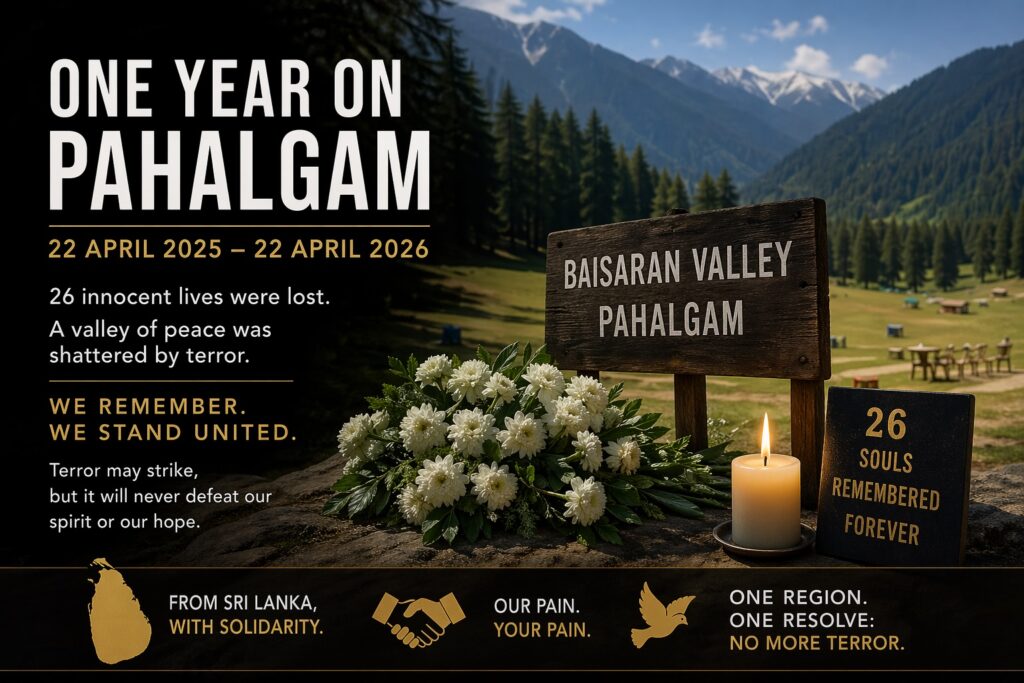
One year ago, the quiet beauty of Baisaran Valley in Jammu and Kashmir was shattered by gunfire.
On April 22, 2025, what began as an ordinary afternoon in one of India’s most picturesque tourist destinations ended in tragedy. Visitors had gathered to enjoy the sweeping meadows — a place fondly known as “mini-Switzerland” — when armed militants emerged from the surrounding forests and opened fire. In a matter of minutes, 26 civilians were killed in the deadliest attack on civilians in India since the 2008 Mumbai attacks.
Today, as the anniversary passes, the memory remains raw — not just for the families who lost loved ones, but for a region that was beginning to rediscover a sense of normalcy.
For those of us in Sri Lanka, this moment resonates deeply.
We know what it means for joy to turn suddenly into grief. On April 21, 2019, our own Easter Sunday was torn apart by coordinated bombings across churches and hotels, killing more than 260 people. Like Pahalgam, those attacks were not random. They were carefully planned, targeting places of peace, faith, and leisure — spaces meant to represent safety.
The parallels are difficult to ignore.
In both cases, the violence was directed at civilians, and more specifically, at the idea of normal life. In both cases, tourism — a symbol of openness and recovery — was deliberately targeted. And in both cases, the intent went beyond immediate loss of life. It was to send a message: that stability is fragile, and that fear can return at any moment.
The Pahalgam attack bore all the hallmarks of calculated terror. Eyewitness accounts revealed that victims were singled out based on their religious identity before being shot. The attack was claimed by The Resistance Front (TRF), widely seen as a proxy of the Pakistan-based Lashkar-e-Taiba — a group long associated with cross-border militancy.
Subsequent developments have reinforced concerns about the origins and structure of such attacks. Security operations later identified individuals linked to the incident, some of whom were traced back across the border. The pattern is one that has been observed repeatedly over the years: organised networks, external support, and the use of proxy actors to sustain instability.
But beyond attribution, anniversaries such as this compel us to ask deeper questions.
Why do such attacks continue to occur? Why do cycles of violence persist even as regions attempt to rebuild? And perhaps most importantly, what lessons remain unlearned?
For Jammu and Kashmir, the attack came at a critical time. Elections had been successfully held, tourism was on the rise, and there were visible signs of economic and social recovery. The violence sought to interrupt that trajectory — to replace confidence with uncertainty.
We saw this pattern in Sri Lanka as well. The Easter attacks dealt a devastating blow to a recovering tourism sector, with immediate consequences for livelihoods, investment, and national morale.
This is what makes such acts particularly insidious. They are not just attacks on people. They are attacks on progress.
They target economies as much as individuals. They aim to isolate communities, deter visitors, and create a lingering sense of insecurity. In that sense, terrorism becomes a form of economic warfare — one designed to weaken from within.
One year on, remembrance must be accompanied by reflection.
For South Asia, where histories, geographies, and vulnerabilities intersect, there is a shared responsibility to confront the conditions that allow such violence to persist. This includes not only strengthening security responses, but also addressing the broader networks — financial, ideological, and logistical — that sustain acts of terror.
At the same time, there is a need to reaffirm resilience.
The return of visitors to places like Pahalgam, just as tourists eventually returned to Colombo, sends a powerful message. It signals that fear, while disruptive, does not have the final word. Communities rebuild. Economies recover. Life, however fragile, continues.
But resilience alone is not enough.
If anniversaries are to mean anything, they must serve as moments of accountability — reminders that behind every statistic are lives interrupted, families broken, and futures altered. They must also prompt renewed urgency in addressing the root causes and enablers of violence.
Because the question that lingers, one year after Pahalgam and years after Colombo, is not just about what happened.
It is about whether enough has been done to ensure it does not happen again.
Sharing is caring!